
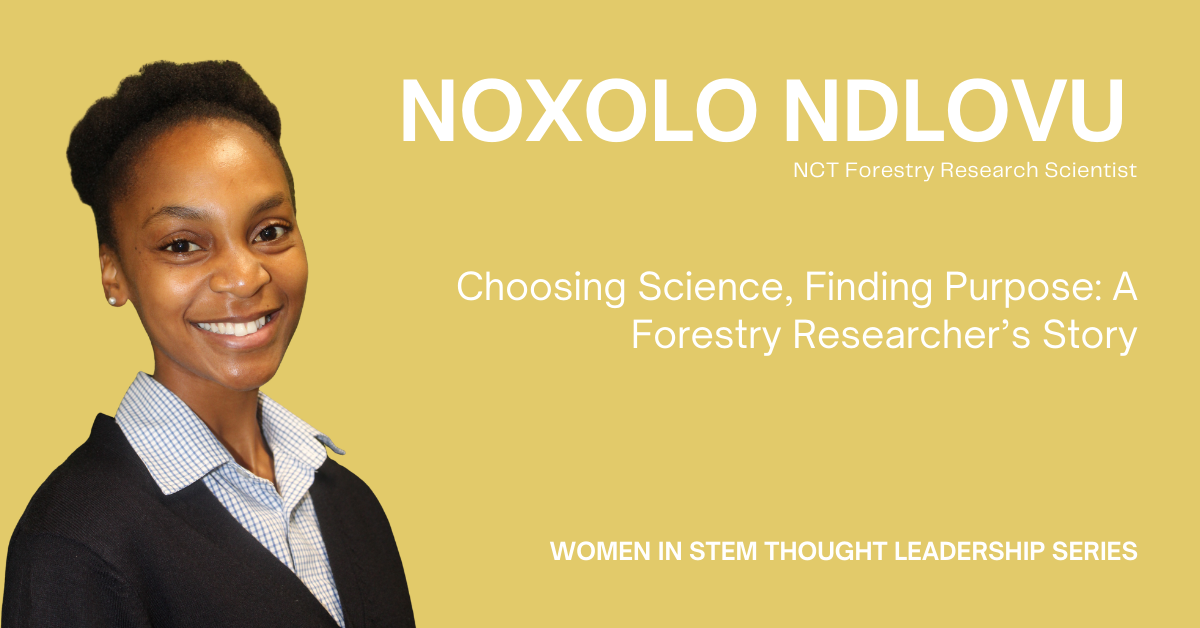
If someone had told me at 15 years old that I would one day hold a PhD in Forestry, I would not have believed it. My name is Noxolo Ndlovu, and I am now a forestry researcher at NCT Forestry. I am part of a team that directs research to ensure the sustainability of NCT and the small- and medium-scale growers affiliated with NCT.
After about 10 years of studying, I obtained my PhD in Forestry in 2024 — an achievement that I am especially proud of and deeply grateful for. I would like to reflect on my personal journey of how I got here and hopefully spur a young reader to consider a career in STEM, particularly a career in forestry.
My journey really took root and direction in Grade 10, when I chose mathematics, life sciences and physical sciences as my major subjects. Honestly, I was not one of those students who were focused and top of their class in primary school and early high school, and so I do not really remember how I ended up choosing subjects that are notoriously known for being difficult.
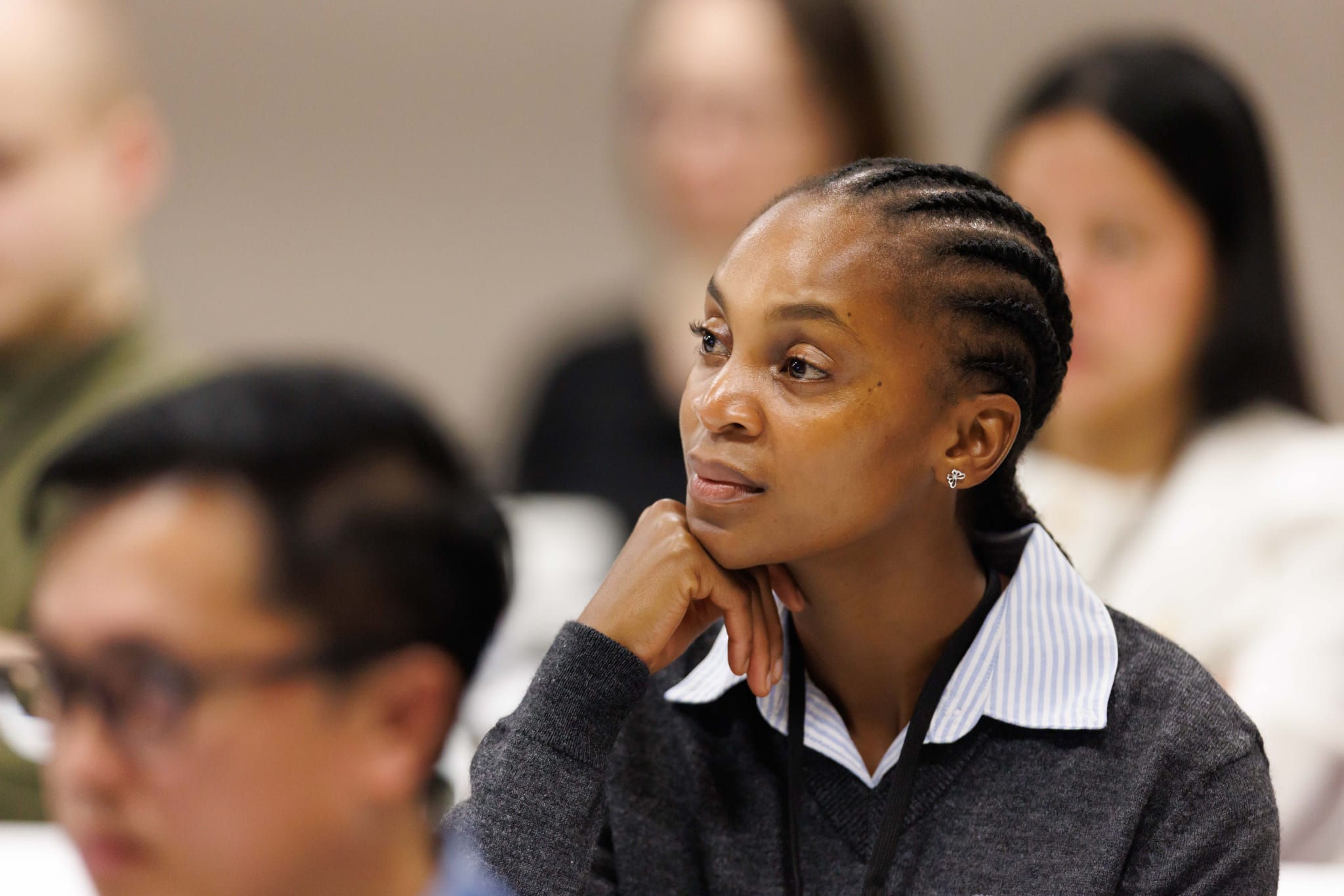
I am glad that I did, though, because in Grade 11 I fell in love with life sciences. I loved learning about the structure and function of living organisms. My teacher, Mrs Gevers, was incredibly passionate and had the gift of explaining complex concepts in a simple and understandable way. She made science feel accessible; she made it feel like it was not a field reserved for a select few, but that with hard work, passion and interest, it was within reach. I knew back then that whatever career path I chose in the future, life sciences had to be at the centre of it.
Alongside life sciences, I enjoyed chemistry and mathematics. My brain could make sense of the concepts and principles taught, and I found that exciting. Of course, that is not to say it was easy. I still had to work hard, persevere, prioritise learning and studying, and actively seek help whenever there was something I did not understand.
At that time, I did not know that there were so many careers in science. Whenever I thought about STEM subjects and careers, all that came to mind were careers focused on human health (like doctors, dentists and the like) or engineering. Never did I consider forestry to be a possible career path. In fact, the little that I knew about forestry was shaped by what I saw around me: people from my village who worked there were referred to as abasebenzi basemaplazini, which translates to “workers from the farms”. These were mostly men and women who had not finished school. I would sometimes see them on my way to school, riding labour trucks in the rain or freezing weather, going to work. Somehow, I also knew that their managers were not people who looked like me — young, African, female. So, there was nothing appealing about the field.
In Matric, however, science students (including myself) were fortunate to have a representative from Mondi come and introduce us to the field of forestry. I found it fascinating that he specifically targeted science students. A few months later, I received a bursary from Mondi and officially began my journey into forestry. As soon as I started the programme, it made sense why science students were such a good fit for the field. Growing trees is a science: it requires understanding tree anatomy and physiology, predicting growth patterns, and applying mathematics and physical sciences to model yields, water use and forest responses to environmental conditions.
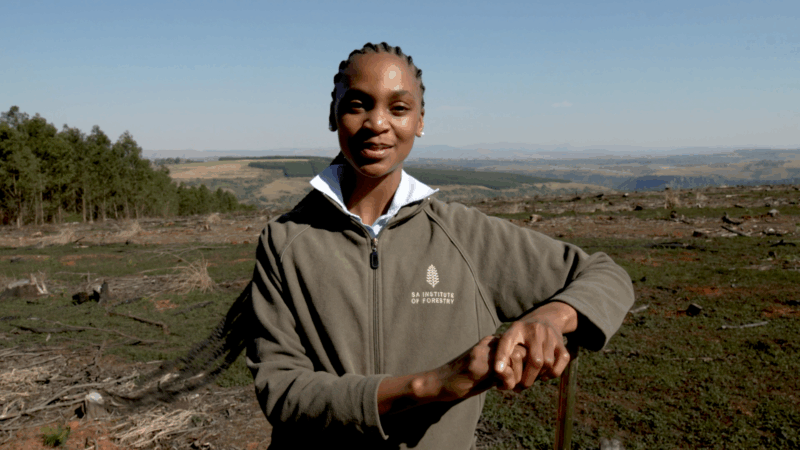
Fifteen years after my initial introduction to forestry, I am deeply grateful that this has been my path and my story. Forestry is a field grounded in integrity and long-term thinking. Perhaps this is because sustainability sits at the heart of what we do. Forestry is a career of both the present and the future. Our trees play a key role in reducing carbon dioxide in the atmosphere, directly contributing to climate change mitigation. While trees are harvested, areas are replanted, and young trees actively capture carbon as they grow.
Beyond the trees themselves, forestry management is guided by respect for the environment and future generations.
Forestry is guided by strong voluntary standards and legislative requirements that ensure operations do not cause harm to the environment, while also respecting and encouraging biodiversity within plantations. Beyond the environment, the forestry industry supports rural communities and contributes meaningfully to South Africa’s economy. It is a holistic industry — caring for people, the environment and the economy.
Science is important because it teaches us how to understand the world, ask better questions and develop solutions to complex challenges. In forestry, science drives innovation — from improving how we grow trees, to finding better and more sustainable uses for wood-based products. Looking ahead, innovation in this space has the potential to reduce reliance on industries with heavier environmental footprints, offering alternatives in areas such as energy, fuels and materials. Science allows us to imagine and build a future that is both productive and responsible.
To young girls who may be wondering whether STEM is for them: the world needs your curiosity, your questions and your perspective. STEM careers are not reserved for a select few — they are built by ordinary people who are willing to learn, persist and believe that they belong!