Registration and Sponsorship closing date: 30 October
Thank you to our Sponsors
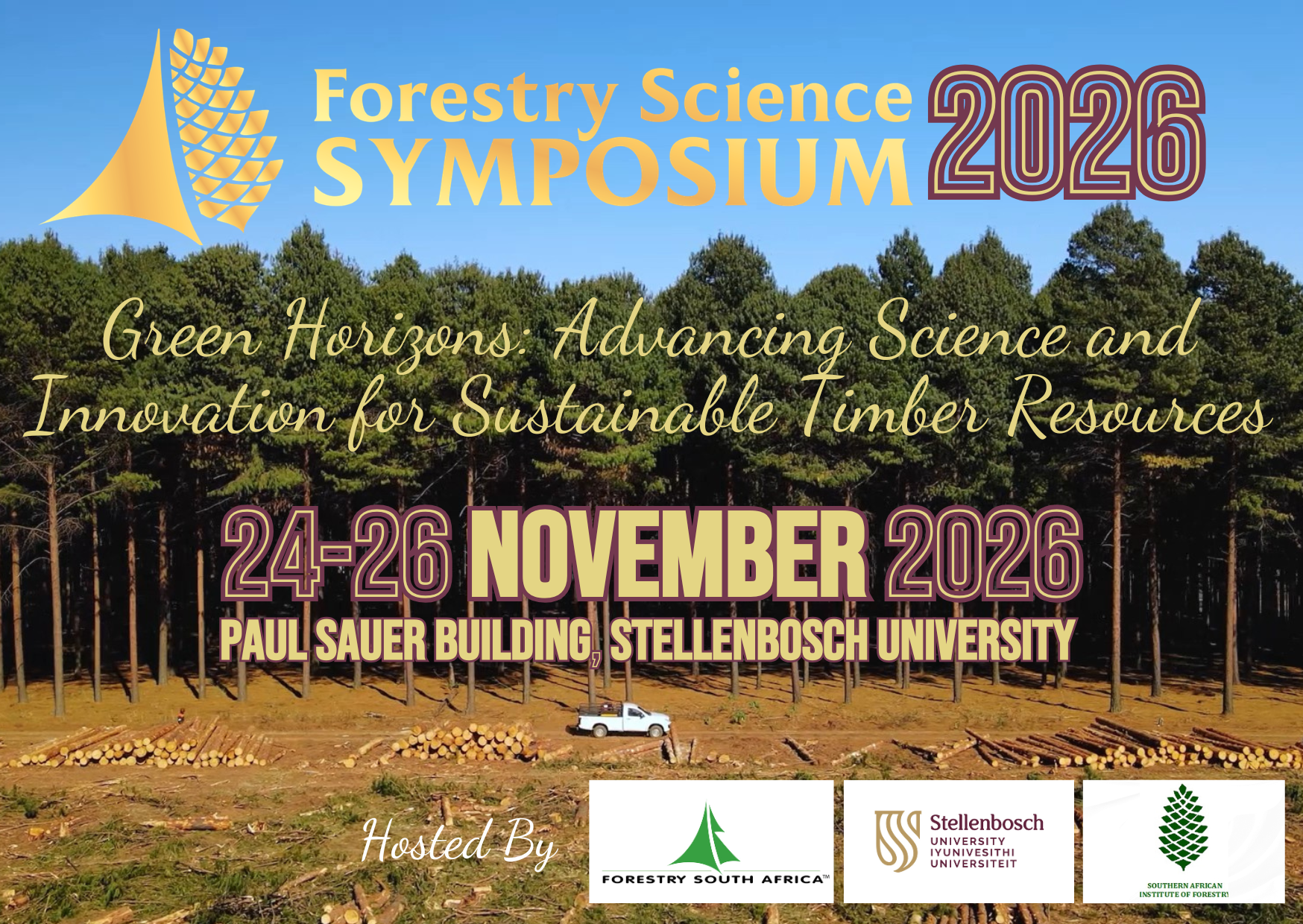
Forestry Science Symposium 2026 Green Horizons
This symposium will bring together researchers, practitioners, industry leaders, policymakers, and students to explore how science and innovation can strengthen the sustainability, resilience, and value of South Africa’s timber resources. The programme is designed to reflect both the established strengths of the sector and the emerging challenges shaping its future, including climate resilience, forest health, biodiversity, digital forestry, advanced tree improvement, wood products innovation, and sustainable production systems. The aim is to promote dialogue across the full forest value chain, from genetics and silviculture to sensing, processing, and ecosystem stewardship.
Platinum Sponsor

Silver Sponsor

Platinum Sponsor

Silver Sponsor

Gold Sponsor

Exhibitor

Symposium Themes
Climate-Resilient Forestry Systems
This session will focus on how forestry systems can adapt to increasing climatic variability and long-term environmental change. Topics may include drought resilience, fire risk, water and soil security, species-site matching, plantation adaptation, and management responses that sustain productivity under changing conditions. The session is intended to frame climate change not only as a threat, but as a design challenge for future timber systems.
Biodiversity & Ecosystem Services
This session will examine how productive timber landscapes can also support biodiversity, ecological function, and long-term sustainability. Suggested topics include conservation planning in plantation mosaics, restoration, catchment protection, ecological monitoring, ecosystem services, and stewardship partnerships between industry and environmental stakeholders. This theme is especially relevant in South Africa, where large forestry landholdings often include significant conservation areas and biodiversity commitments.
Organising Committee
Wood Quality, Forest Products & Value Chain Innovation
This session will explore the downstream dimensions of sustainable timber resources, linking forest science to wood quality, product performance, processing, and innovation across the value chain. Topics may include wood formation, timber quality, fibre properties, engineered products, processing efficiency, and new product opportunities in the forest bioeconomy.
Precision Forestry, Sensing & Decision Support
This session will focus on digital technologies that improve forest measurement, monitoring, planning, and operational decision-making. Topics may include remote sensing, UAVs, LiDAR, AI, machine learning, GIS, digital inventory systems, and analytics that support smarter forestry operations. This theme captures the symposium’s focus on innovation and reflects the increasing role of data-driven tools in both research and practice.
Advanced Tree Improvement, Genomics & Deployment
This session will highlight recent advances in breeding, genomics, propagation, and deployment strategies for future timber systems. It should include topics such as genetic gain, clonal forestry, molecular tools, resilience traits, breeding for drought and disease tolerance, and the translation of research into operational deployment.
Forest Health & Emerging Biotic Risk
This session will address the biological threats that continue to challenge plantation forestry, including pests, pathogens, invasive species, and changing risk profiles under global trade and climate pressure. Emphasis should be placed on surveillance, diagnostics, resistance, integrated protection, and interdisciplinary responses to forest health threats.
Silviculture & Sustainable Timber Production
This session will focus on the management of timber resources across the production cycle, including stand establishment, nutrition, site productivity, silviculture systems and management practices that support long-term sustainability. It provides an important foundation for the symposium by linking biological understanding with practical forest managment and resource stewardship.